
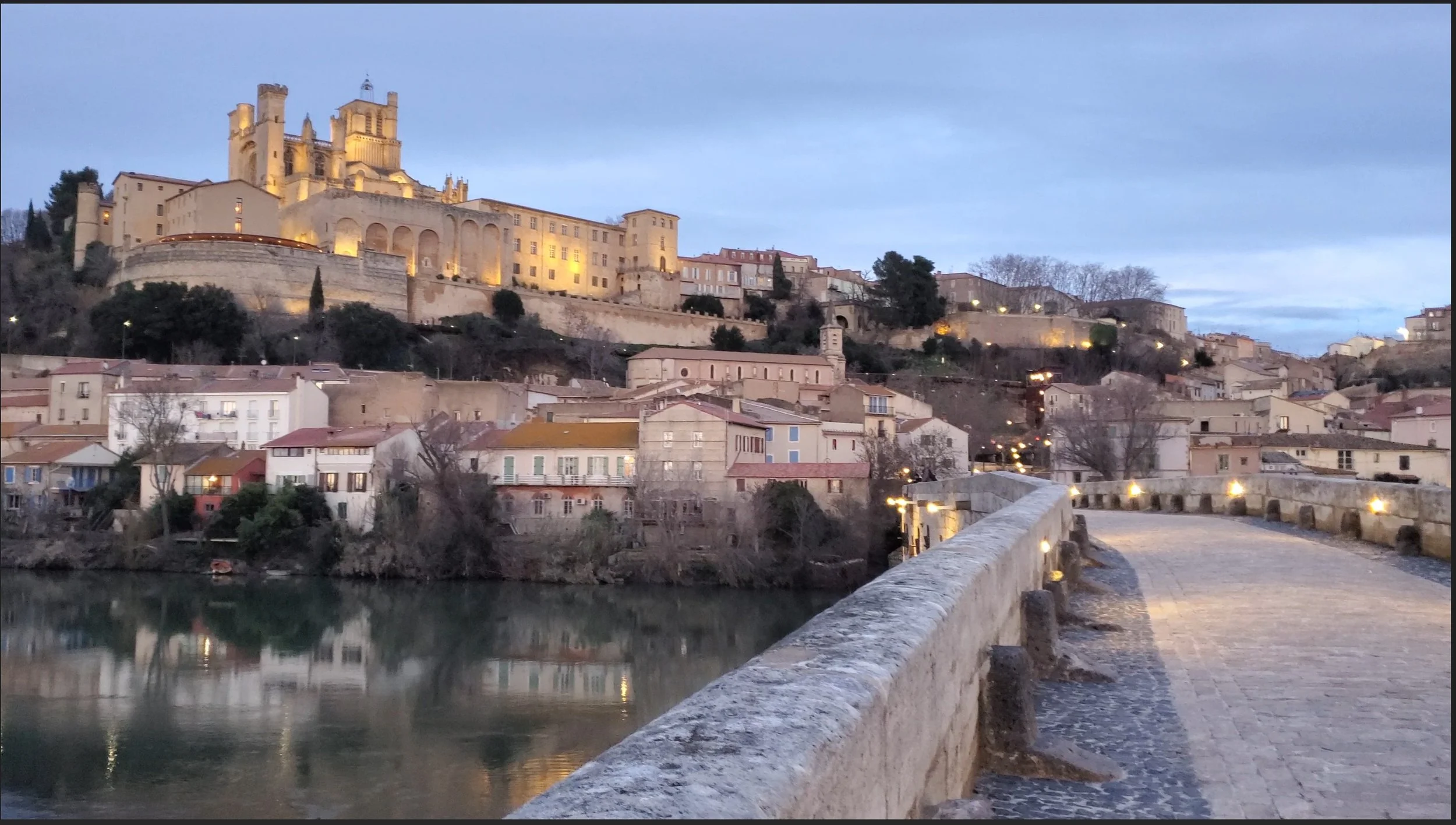
Cathedral on the Hill.
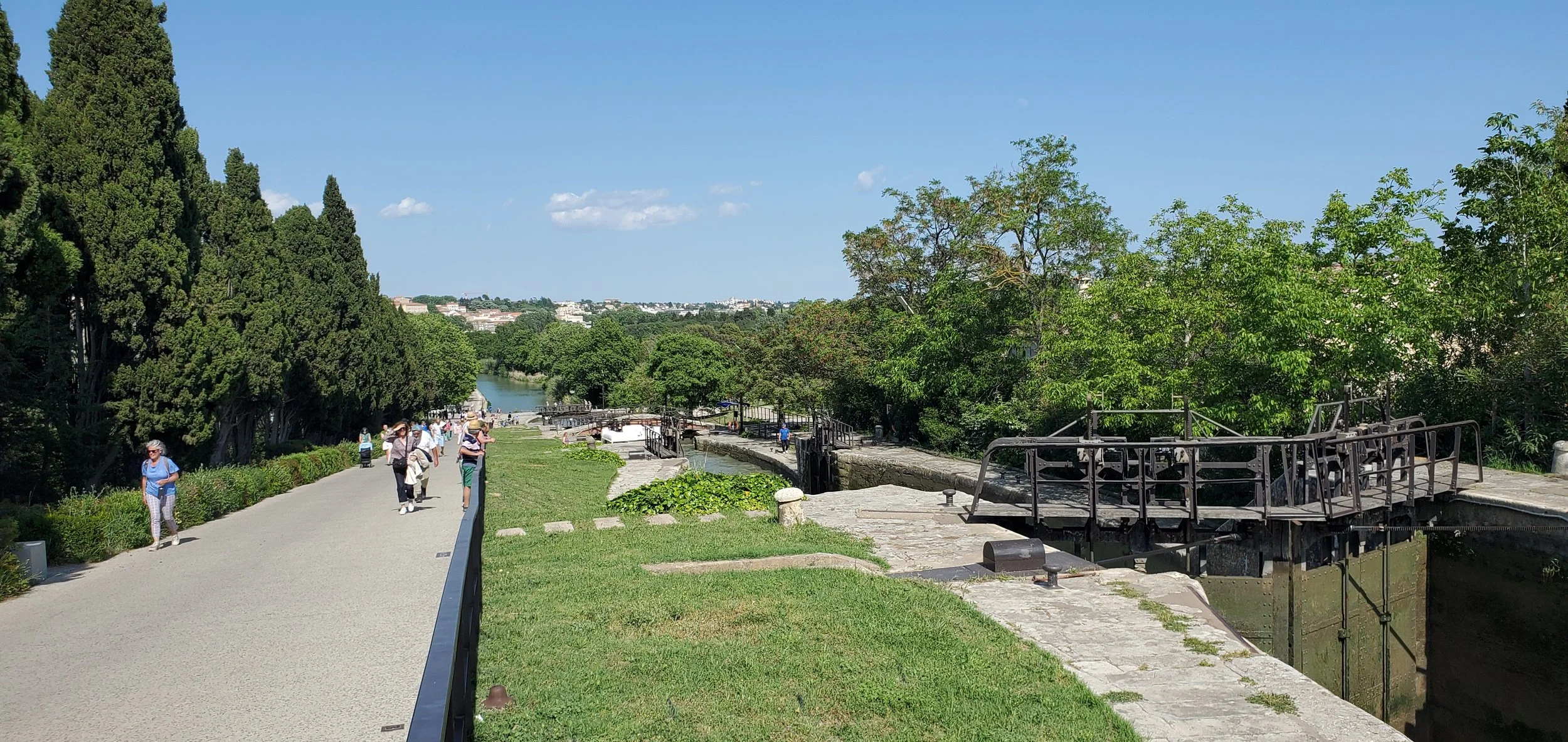
Canal in the Valley.
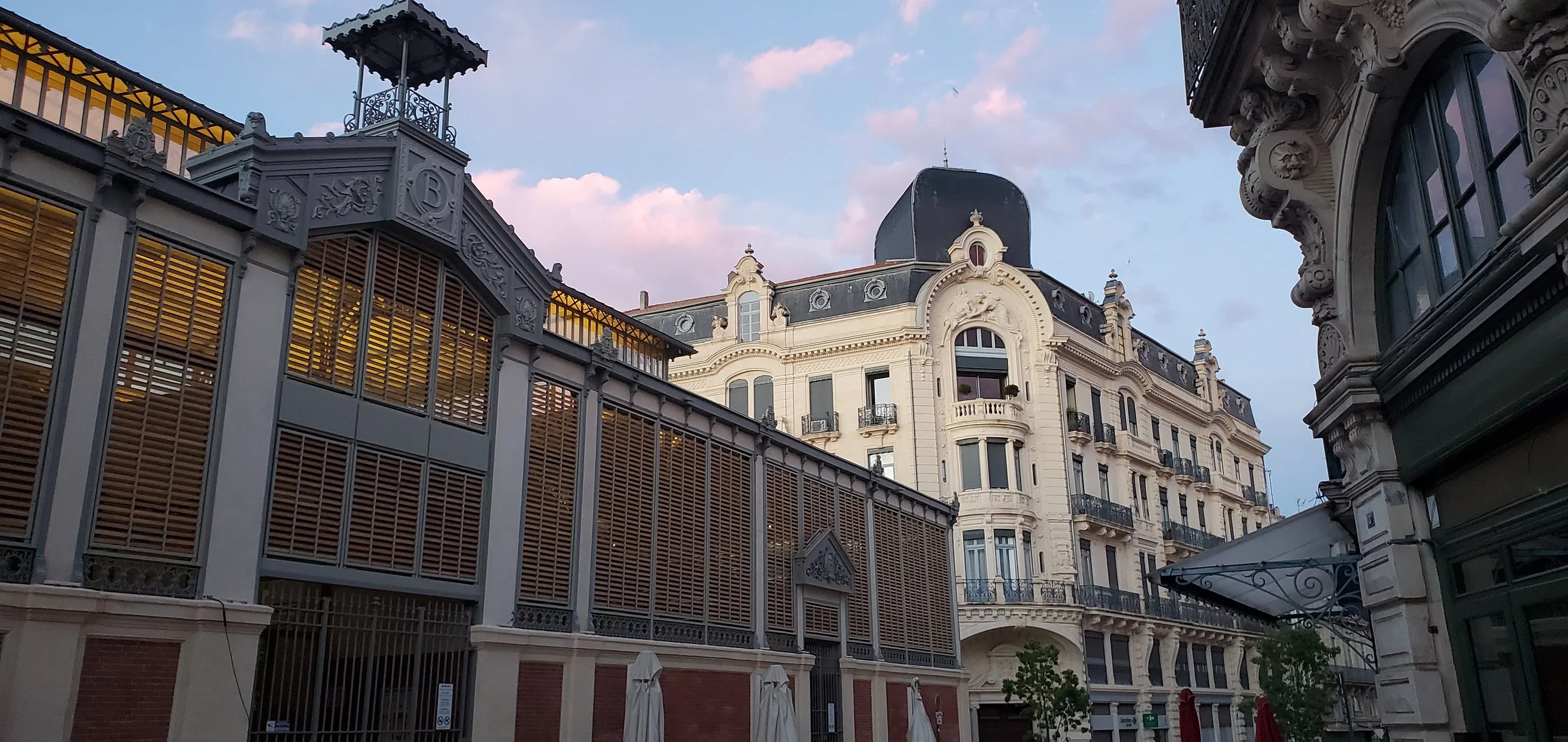
Market in Between.
Béziers is a working southern French city. Less crowded than Montpellier, more affordable than the coast, and easier to experience as a real place than most towns in the region.
Full video: This Historic French City Should Have Worked for 80 NightsThis Historic French City Should Have Worked for 80 Nights
Getting Oriented in Béziers
Two distinct atmospheres separated by a hill.
Béziers sits on a promontory above the Orb River. The cathedral and old city are at the top. The river, the Pont Vieux, the Canal du Midi and the Nine Locks at Fonseranes are below. That elevation difference shapes everything — how you move, how long walks take and where you'll want to rest.
From the cathedral terrace, you can see rooftops, vineyards, stone bridges and the broad countryside. Walk down toward the river and everything shifts — greener, quieter, slower, with boats moving beneath plane trees.
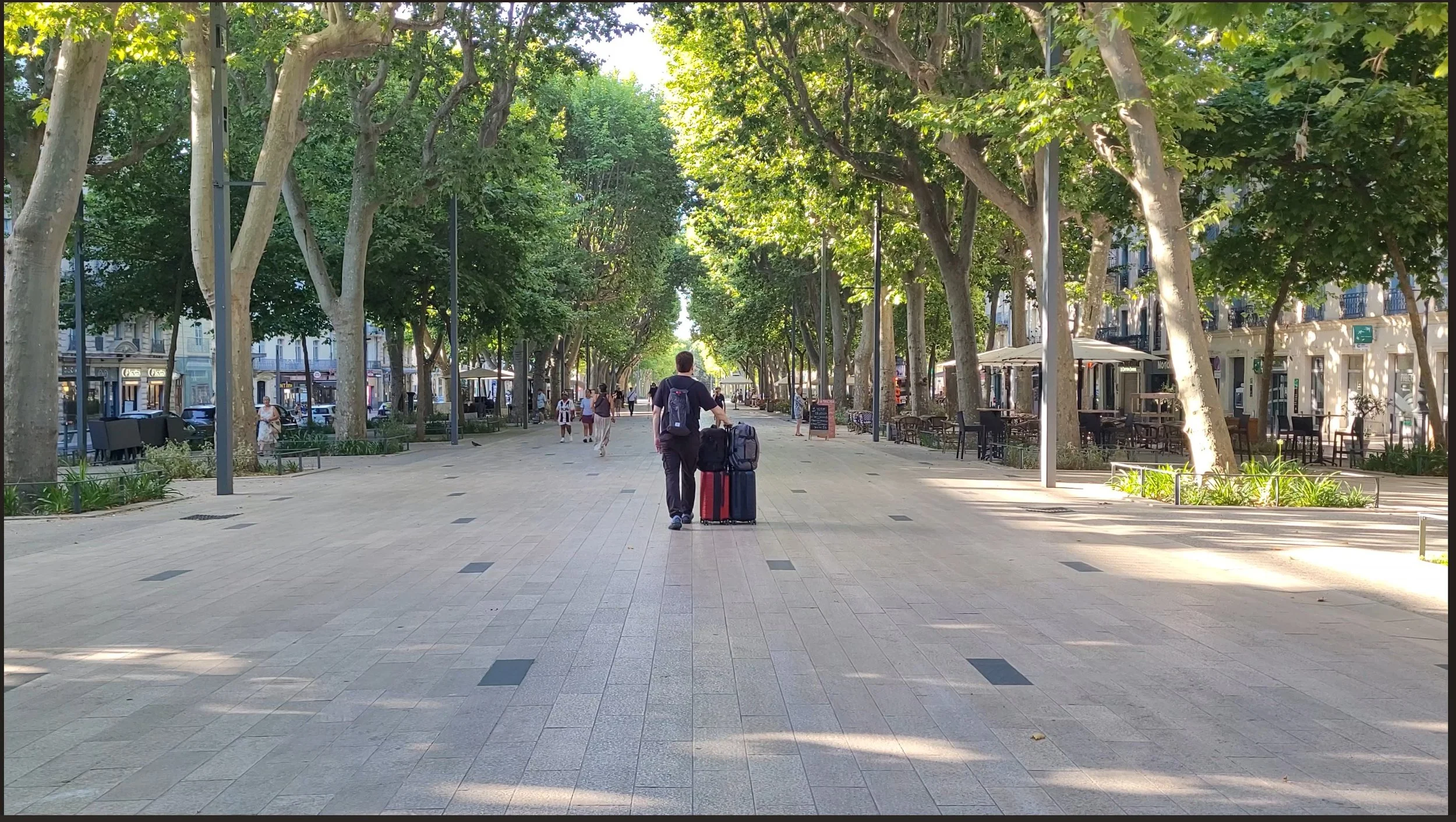
Daily life gathers around Les Halles, Place Jean Jaurès and Allées Paul Riquet. Mornings bring shoppers, bakery stops and busy café terraces. By early afternoon the pace drops. Side streets grow quiet, shutters close against the heat and the city settles into the slower rhythm typical of southern France.
Some streets in the old center are beautiful and atmospheric. Others feel worn, quiet or residential. That unevenness is part of the character — and part of what makes it feel like a real place.
Dense, historic, urban
Stone streets, churches, the covered market, shaded squares, the cathedral terrace with its wide views. This is where most of the sightseeing happens and where the city's weight and age are most visible.
Green, calm, wide open
The Pont Vieux, the Orb riverbanks, the Canal du Midi towpaths, and Fonseranes with its staircase of locks. A completely different pace — boats move slowly, plane trees give deep shade, the city becomes a backdrop.
Top 5 Things to See
From the cathedral above to the locks below.
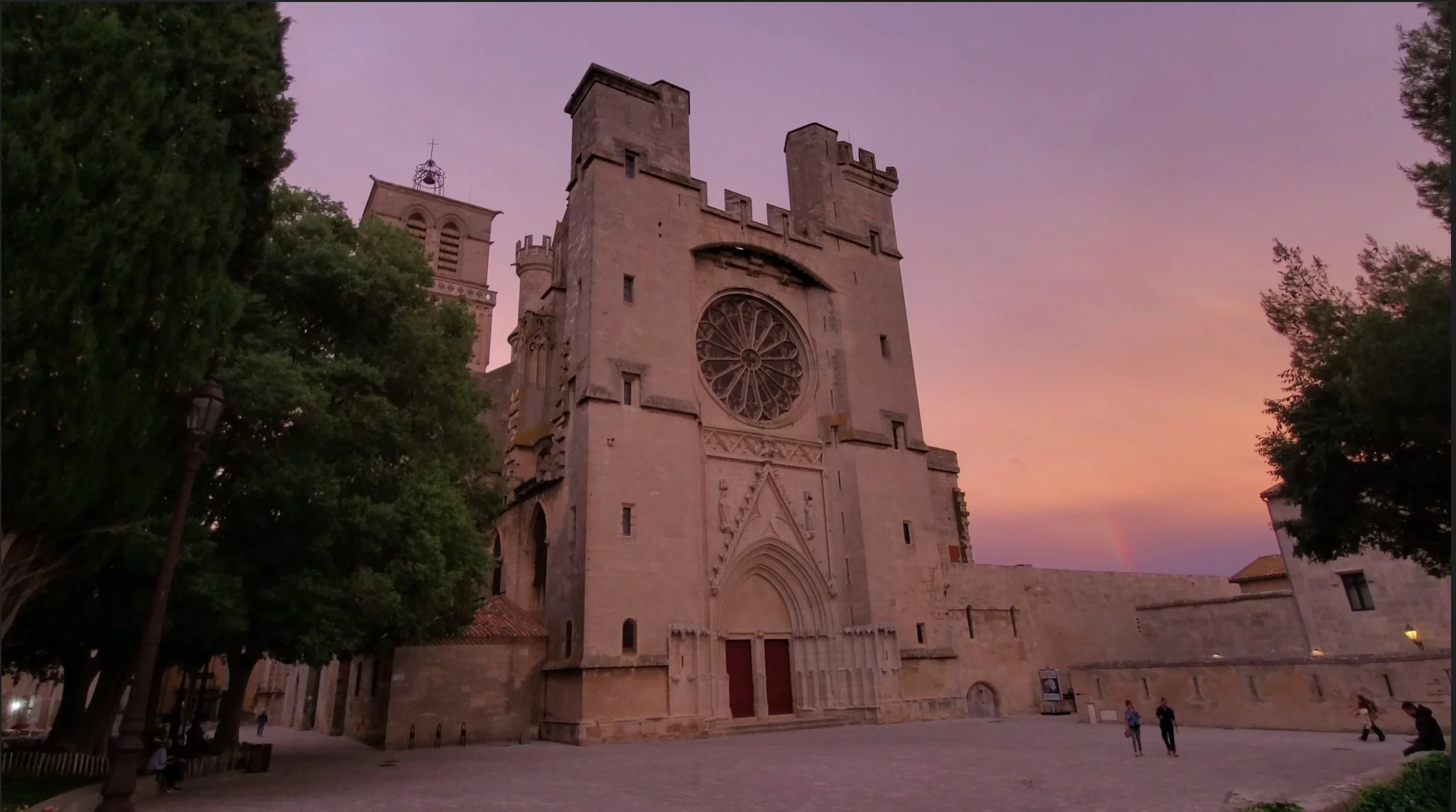
Cathédrale Saint-Nazaire
The cathedral stands on a high promontory above the Orb with wide views across vineyards, bridges and the surrounding countryside. The setting is as important as the building. Walk around the terrace and down toward the river to understand how dramatically the old city rises above everything below.
The Nine Locks of Fonseranes
A staircase of locks built to move boats through a major change in elevation along the Canal du Midi. The sequence extends roughly 315 metres and overcomes approximately 25 metres of elevation. Landscaped paths, viewpoints and places to watch boats pass through. About two kilometres from the historic center.
The Pont Vieux and the Orb River View
The Pont Vieux provides the classic view of Béziers — stone bridge crossing the Orb, cathedral and old city rising behind it. Walk across, continue along the river and look back toward the cathedral. Morning and late afternoon give the best light. The view shows Béziers as a complete landscape, not just a collection of monuments.
Les Halles and Allées Paul Riquet
Les Halles was renovated in 2024 and named France's most beautiful market in a 2025 competition. Allées Paul Riquet is the broad central promenade lined with cafés, shops and plane trees — the dividing line between the oldest streets and the more commercial center. Together they show Béziers as a working city, not just a historic one.
Plateau des Poètes
A landscaped 19th-century park between Allées Paul Riquet and the railway station, with ponds, statues, mature trees, fountains and elevated paths. Classified as a historic monument since 1995. A useful and pleasant walking route between the station and central Béziers.
Top 5 Things to Do
The walk, the canal, the market, the wine.
- Walk from the cathedral to the Nine Locks. Begin at the cathedral, descend toward the Pont Vieux, follow the Orb and continue to Fonseranes. This turns several separate attractions into one coherent half-day and is the best way to understand Béziers geographically. Bring comfortable shoes and water — the route includes hills, uneven paving and exposed sections in warm weather.
- Take a Canal du Midi cruise. Short sightseeing cruises operate around the canal and Fonseranes. Longer excursions may include lunch or travel farther through the countryside. Particularly worthwhile if you're interested in engineering, canals or slow travel. Schedules vary considerably by season — better availability from spring through early autumn.
- Eat and browse at Les Halles de Béziers. Produce vendors, butchers, seafood counters, prepared-food stands, wine merchants and places to sit down for a meal. Tuesday through Saturday 8am–11pm, Sunday 8am–6pm, closed Monday. For the strongest market atmosphere, go before lunch rather than late afternoon.
- Visit a vineyard or taste Languedoc wine. Vineyards begin almost immediately outside the city. Local wine lists include bottles from Saint-Chinian, Faugères, Picpoul de Pinet and the broader Languedoc appellation. A vineyard visit is much easier with a car. Without one, a wine bar or merchant in central Béziers can offer a tasting flight.
- Take a day trip to the Mediterranean or a nearby town. Valras-Plage is the closest beach. Narbonne, Sète, Montpellier and Agde are all reachable by train. Pézenas is known for preserved architecture and antiques. Carcassonne is possible by train but deserves a full day. A car gives much more flexibility for beaches, wineries and villages.
Top 5 Things to Eat
Languedoc and Mediterranean food culture, with a few local traditions.
Béziers cuisine is part of the wider Languedoc and Mediterranean food culture. Some dishes are distinctly connected to the city; others are regional specialties widely found in and around Béziers. Wine should be considered part of eating here, not just a drink alongside it.
Where to Stay
For a first visit, stay within ten minutes of Place Jean Jaurès.
That gives you the best combination of food, transportation, atmosphere and manageable walking. The area around Allées Paul Riquet and Les Halles is the most balanced base for most visitors.
Historic center near the cathedral
Within walking distance of the main sights and many restaurants. Visually distinctive and works well for short stays. Trade-offs: steep streets, limited parking, variable building quality, occasional nighttime noise. Check for elevator and air-conditioning before booking.
Allées Paul Riquet and Place Jean Jaurès
The most balanced location. Convenient access to cafés, shops, the historic center, Plateau des Poètes and the station — without the steepest medieval streets. More open and active than the cathedral quarter. Easier for taxis and luggage.
Plateau des Poètes and the station side
Useful when arriving late, leaving early or taking day trips by train. The walk through Plateau des Poètes to Allées Paul Riquet is pleasant and direct. Choose a property closer to the park rather than the immediate station blocks.
Residential areas with a car
Areas east or northeast of center can offer larger apartments and easier parking. Less atmospheric for a first visit but practical for a week or more. Check walking distances carefully — "central Béziers" in listings can mean farther than expected.
Getting Around Béziers
Compact but not flat — the hill matters every day.
Central Béziers is compact and most attractions are reachable on foot. But it is not flat. The cathedral and oldest streets sit above the river, while the station, the Orb, the canal and Fonseranes are lower. Routes can include steep slopes, steps, cobblestones and uneven pavement.
Someone comfortable walking three to five miles in a day can see most of the city without needing transit. For Fonseranes or reducing the uphill return to the center, local buses are useful — check current timetables as service thins at night and on Sundays.
When a car actually helps
A car is unnecessary for central sightseeing. It becomes valuable for vineyards, small villages, remote beaches, rural restaurants and multiple destinations in one day. Parking in the historic center is difficult — use a public garage rather than relying on street parking.
When to Go
Late April through June and September through early October are the strongest months.
March can be windy and changeable. April and May are more reliable — vineyards and parks are green, outdoor sightseeing is easy, crowds are manageable. Excellent for walking, cycling and vineyard visits.
Hot, dry and bright. Average July highs around 29°C / 84°F, heat waves possible. August brings the Feria de Béziers — the city becomes extremely busy, loud and festive. Strong for nightlife and atmosphere; poor for a quiet stay. Accommodation prices rise substantially around the Feria.
September is often excellent — warm weather, functioning visitor services, fewer crowds. The grape harvest adds interest across the surrounding wine region. October can still be pleasant but statistically wetter. November is quieter and cooler.
Generally mild compared with northern France but not a winter-sun destination. The city remains functional as a real year-round community. Canal cruises and seasonal businesses may close. Evenings can feel very still. Best for lower prices and local life.
How to Get to Béziers
Better connected by rail than its size suggests.
Béziers lies on the main rail corridor connecting Montpellier, Sète, Agde, Narbonne, Perpignan, Toulouse, Marseille, Lyon, Paris, Girona and Barcelona — much better connected than its size might suggest.
Often the simplest option when Paris fares are competitive. Fastest trains take just over four hours, some direct. From Charles de Gaulle you can take a connecting train when available or travel into Paris for a train from Gare de Lyon. Allow substantial connection time after an international arrival.
A strong option when Barcelona airfare is lower. Direct trains from Barcelona-Sants take approximately two and a half hours, though there may be only a few direct departures per day. Works well for travelers combining southern France with Spain.
The nearest major year-round airport with broader European connections. Travel into Montpellier and take a regional train to Béziers — as little as 37 minutes, with frequent daily departures. The easiest option if you can get a reasonable fare.
The local airport handles a limited seasonal network including London, Bristol, Manchester, Edinburgh, Brussels, Düsseldorf, Stockholm and Shannon. A shuttle connects to Béziers station for €2 each way. Treat it as a convenient bonus for the right routes rather than the foundation of a complicated itinerary.
Paris: just over four hours, some direct. Montpellier: 37–55 minutes, frequent trains. Sète: 20–30 minutes. Narbonne: 15–25 minutes. Toulouse: 90 minutes to two hours. Marseille: two and a half to three hours. Lyon: three to four hours. Check actual travel-day schedules rather than relying on generic journey times.
Practical Things to Know
One day feels rushed. Two nights is the best minimum — one day for the center, one for the canal or a nearby destination. Three to four nights works for a relaxed visit with a beach or vineyard day trip. A week or longer suits travelers using Béziers as an affordable base.
Bakery breakfast €5–10. Casual lunch €15–25 per person. Dinner with drinks €30–55 per person. Market picnic €10–20 per person. Basic hotel outside major events €65–110 per night. Comfortable central hotel €100–170. August Feria dates: significantly higher across the board.
Sunday mornings are active around bakeries and cafés, but many shops close by afternoon. Monday is commonly a closing day for independent restaurants and some attractions. Les Halles is currently closed on Mondays. For a short visit, check individual schedules before making Monday your main day.
Spoken at hotels, the tourism office and some visitor-oriented restaurants. Less consistently used than in Paris or major resorts. Basic French greetings and simple restaurant vocabulary are useful. Menus may be French-only in smaller traditional establishments.
Slopes, stairs, cobblestones and uneven medieval streets make Béziers difficult for travelers with limited mobility. The easiest base is near Allées Paul Riquet or Place Jean Jaurès. Use transportation for Fonseranes and the riverfront rather than attempting every elevation change on foot.
Works well for travelers who prefer smaller cities, enjoy markets and wine, are passing through southern France by train, or want an affordable base near the Mediterranean. Less satisfying for anyone expecting a glamorous Riviera atmosphere or a fully tourism-ready historic center.
Bottom Line
Béziers is less elegant than Montpellier, less maritime than Sète, less monumental than Carcassonne and less polished than Provence's most famous towns. It is also less crowded, more affordable and easier to experience as an ordinary place where people actually live. Its real personality appears in the morning at Les Halles, over coffee on Allées Paul Riquet, along the canal towpath and during the slow transition between busy market hours and quiet afternoons. For a tourist, it is strongest as a two- or three-night cultural stop with excellent regional access. Its value for longer stays comes from affordability, train connections, markets and proximity to beaches and vineyards — not from having an endless list of headline attractions.
Back to top ↑